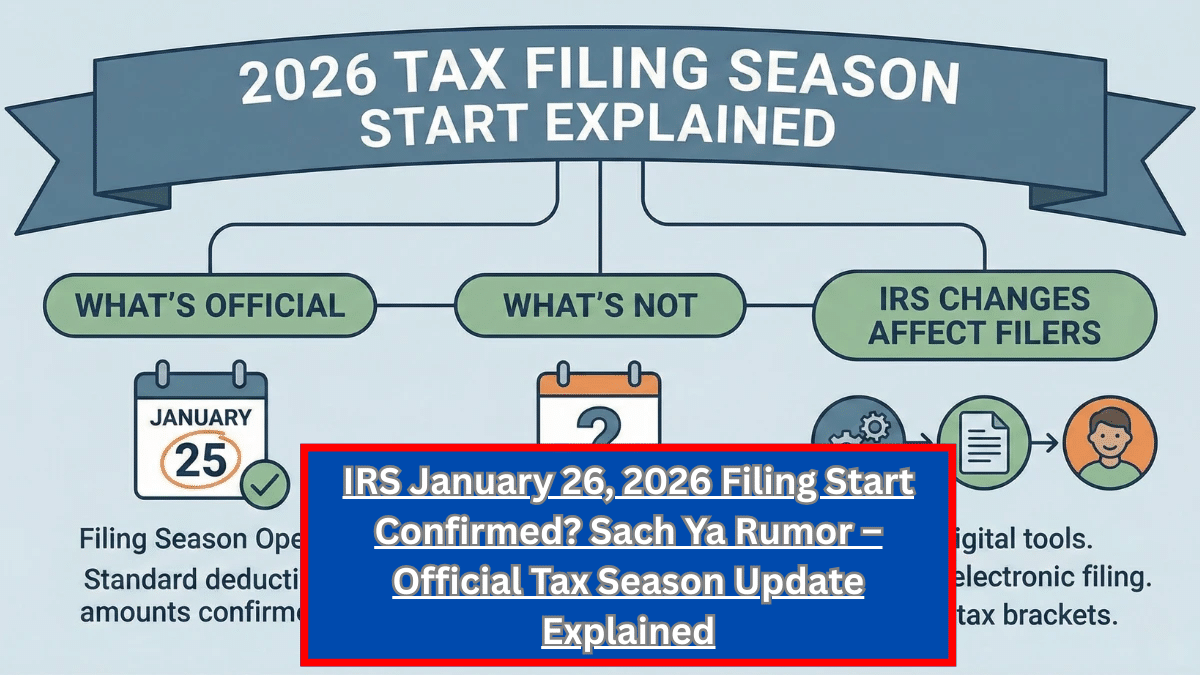
Reports claiming that January 26 has been officially set as the start date for the 2026 tax filing season have circulated widely across financial blogs and social media platforms. Some posts also suggest that new tax law changes will take effect immediately when filing opens, creating urgency among taxpayers to prepare early.
However, it is important to clarify the verified reality: the IRS has not officially confirmed January 26 as the opening date for the 2026 filing season.
Each year, the official start of tax season is announced only through formal communication from the Internal Revenue Service. Until that announcement is made, any specific date circulating online remains unconfirmed.
This article explains how filing season start dates are determined, what influences the timeline, and what taxpayers can realistically expect from the IRS for 2026.
Searchable Focus Keywords: IRS filing season 2026 start date, January 26 tax season rumor, IRS 2026 tax update, when does IRS open filing 2026
Key Highlights: January 26 Claim vs Official IRS Status
| Claim Circulating | Official Status |
|---|---|
| January 26 start date confirmed | Not confirmed |
| IRS filing calendar released | Not yet issued |
| Tax law changes finalized | Depends on enacted law |
| Returns accepted before announcement | No |
| Filing start applies to all returns | Only after IRS opens systems |
Has the IRS Officially Set January 26 as the 2026 Filing Start Date?
The direct and verified answer is No.
The Internal Revenue Service has not officially announced January 26 as the start of the 2026 tax filing season. While tax seasons often begin in late January, the exact date is determined only after internal system testing, tax form updates, and administrative preparation are completed.
Historically, filing seasons have opened sometime in the second half of January. However, the IRS confirms the official opening date only after ensuring that:
- Electronic filing systems are fully operational
- Updated tax forms are finalized
- Any new tax law provisions are integrated
- Processing software is tested
Until an official IRS press release or notice confirms the start date, January 26 remains speculative.
Taxpayers should rely only on official IRS communications for confirmation.
How the IRS Determines the Filing Season Start Date
The opening of tax filing season is not random. It is based on operational readiness.
Each year, the Internal Revenue Service reviews several factors before announcing the start date:
- System Readiness
IRS processing systems must be updated and tested to handle millions of returns. - Form Availability
Updated tax forms and instructions must be finalized and published. - Legislative Updates
Any new tax laws passed by the United States Congress must be incorporated into forms and software. - Electronic Filing Testing
E-file systems must undergo accuracy and security checks.
Because these steps can vary from year to year, the opening date may shift slightly. Even if previous seasons opened around January 23–29, that pattern does not guarantee the same date in 2026.
The IRS announces the final date only when all systems are confirmed ready.
How Tax Law Changes Could Affect the 2026 Filing Season
Online reports also claim that “new tax law changes” will take effect immediately with the January 26 start date. However, tax law changes occur only when formally enacted by Congress and signed into law.
If tax law changes are passed, the Internal Revenue Service may need additional time to update:
- Tax calculation worksheets
- Income thresholds
- Credit eligibility rules
- Deduction limits
- Processing software
These updates can influence when the filing season opens. However, system adjustments do not automatically delay refunds once returns are officially accepted.
It is also important to note that not every year includes major tax law revisions. If no new legislation is enacted, filing may proceed on a standard timeline.
As of now, there is no confirmed announcement tying new tax law changes to a January 26, 2026 opening.
What Taxpayers Can Do Before Filing Season Officially Opens
Even though returns cannot be submitted before the IRS opens its systems, taxpayers can still prepare in advance.
Preparation steps include:
- Gathering W-2 and 1099 forms
- Reviewing prior-year tax returns
- Organizing receipts and deduction records
- Confirming bank account details for direct deposit
- Selecting tax software or a tax professional
Tax preparation software may allow users to begin entering information early. However, returns will not be transmitted to the IRS until the agency officially opens electronic filing.
Submitting information before the official opening does not provide any advantage. The IRS processes returns only after systems are live.
Being prepared helps ensure faster filing once the season begins, but there is no early submission shortcut.
What Has Not Changed for the 2026 Filing Season
Several key rules remain unchanged regardless of the exact opening date:
- Returns cannot be officially filed before the IRS opens its systems
- There is no penalty for waiting until the official start date
- Filing deadlines remain governed by federal law
- Refund timelines begin only after acceptance
- Early social media announcements do not override IRS authority
The Internal Revenue Service maintains full control over when electronic systems accept returns.
Even if taxpayers complete preparation early, submission is not possible until the official filing start date is announced.
Relying on unofficial calendars or viral posts can create confusion. The IRS provides final confirmation through formal notices and press releases.
Why January 26 Is Being Mentioned Online
January 26 likely appears in online reports because prior filing seasons have opened around similar dates in late January. However, historical patterns do not equal confirmation.
Financial content creators often estimate start dates based on previous years, but only official IRS announcements confirm the exact opening.
Using a specific date such as January 26 may generate clicks or urgency, but without formal confirmation, it remains speculative.
Until the IRS issues an official notice, no specific January 2026 filing start date is guaranteed.
KEY FACTS
- The IRS has not confirmed a January 26 start date for 2026
- Filing season dates are announced officially each year
- Tax law changes can affect system readiness
- Returns cannot be filed before IRS systems open
- Official IRS notices provide the final dates
Conclusion
While late January is a typical timeframe for the beginning of tax season, January 26 has not been officially confirmed as the start of the 2026 filing season. The Internal Revenue Service announces the official date only after completing system testing, finalizing forms, and integrating any legislative updates passed by the United States Congress.
Disclaimer
This article is for informational purposes only and does not constitute tax or legal advice. IRS filing season dates and tax rules are subject to official government announcements.

Written by our editorial team, committed to accurate and responsible reporting.