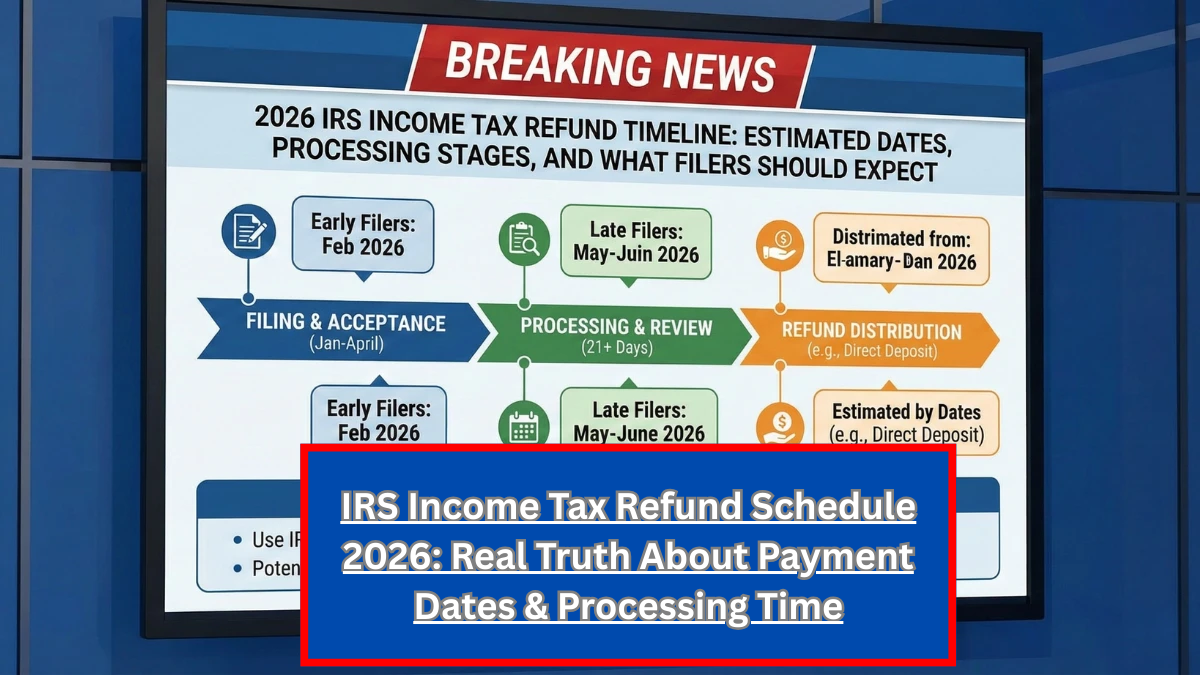
Every tax season, online searches increase for the “2026 IRS income tax refund schedule,” with many websites claiming that exact refund dates and fixed payment charts have already been released. However, to avoid misinformation and spam-style claims, it is important to clarify one key fact: the Internal Revenue Service (IRS) does not publish a guaranteed refund schedule with fixed payment dates.
Refund timing in 2026 will depend on several processing factors, including filing method, return accuracy, and whether additional verification is required. This detailed guide explains how the official IRS refund system works, what realistic timelines look like, and what taxpayers can truly expect.
Focus Keyword: IRS Income Tax Refund Schedule 2026
Key Highlights
Factor | Impact on Refund Timing
Filing method | E-file is faster than paper
Direct deposit | Faster than mailed check
Verification checks | May delay processing
Errors or missing info | Slows approval
Manual review | Adds additional time
Is There an Official IRS Refund Schedule for 2026?
No. The IRS has not released an official refund calendar with fixed dates for 2026. Any charts circulating online are estimates based on prior-year averages.
Refunds are processed individually. Even taxpayers who file on the same day may receive refunds at different times depending on review requirements. The IRS only provides general processing guidelines—not guaranteed dates.
How IRS Refund Timing Is Determined
• When the return is filed
• How the return is filed
• Whether all information is complete and accurate
• Whether credits require additional validation
• Whether identity verification is triggered
Filing early does not automatically guarantee faster payment. If a return is selected for review, processing may pause until verification is complete.
The IRS uses automated systems for most returns, but some filings require manual handling.
Estimated Refund Timing Based on Filing Method
Filing Method | Typical Timeframe
E-file + direct deposit | About 21 days
E-file + paper check | Longer than 21 days
Paper return | Several weeks or more
Return under review | Additional time required
Amended return | Significantly longer processing
Taxpayers who electronically file and select direct deposit generally receive refunds faster than those who mail paper returns.
Why Some Refunds Take Longer in 2026
Refund delays usually occur due to routine verification steps, not penalties or new rules. Common causes include:
• Identity verification requirements
• Income and withholding matching
• Credit reconciliation
• Missing forms or schedules
• Mathematical corrections
• Manual review selection
These procedures protect taxpayers from fraud and ensure accurate refund amounts. While they may extend processing time, they are lawful and standard practice.
Do Refund Amounts Affect Refund Speed?
No. The size of a refund does not determine how quickly it is processed. A small refund and a large refund follow the same review path.
Timing is influenced by:
• Filing accuracy
• Validation requirements
• Processing method
• Verification needs
There is no priority system based on refund amount.
How IRS Refund Status Updates Work
The IRS provides official refund tracking tools that update as returns move through processing stages. These tools show general progress such as:
• Return received
• Refund approved
• Refund sent
Status updates indicate where a return is in the system, but they do not guarantee exact payment dates. Updates may occur once per day.
Taxpayers should rely only on official IRS tools rather than third-party estimate charts.
What Has Not Changed for the 2026 Tax Season
For 2026:
• There are no guaranteed refund calendars
• There are no fixed refund payment charts
• There are no new automatic delay rules
• There are no standard refund amounts
The IRS refund system continues to operate under the same long-standing processing framework used in prior years.
What Taxpayers Should Do
To help avoid delays:
• File electronically
• Choose direct deposit
• Double-check all information before submitting
• Include required forms and schedules
• Avoid filing duplicate returns
• Monitor official IRS refund tracking tools
Contacting the IRS too early does not speed up processing and may increase wait times during peak filing season.
KEY FACTS
• No official IRS refund schedule exists for 2026
• Most e-filed refunds arrive in about 21 days
• Paper returns take significantly longer
• Verification checks can delay refunds
• Only official IRS tools provide accurate refund status
Conclusion
IRS income tax refunds in 2026 will follow the standard IRS processing system. Refund timing depends on filing method, accuracy, and whether additional verification is required—not on fixed payment charts or online estimates.
Disclaimer
This article is for informational purposes only and does not constitute tax or financial advice. Refund timing and amounts depend on individual tax returns and official IRS procedures.

Written by our editorial team, committed to accurate and responsible reporting.