
As New York lawmakers shape the 2026 state budget, many residents have started asking the same question: Is there really a $1,000 New York State tax credit coming? The short answer matters because it affects refund expectations, filing decisions, and household planning — especially for families already stretched by higher living costs.
What’s circulating online is not a promise of a universal payout. Instead, the $1,000 figure is tied to proposed or expanded state-level tax relief programs discussed during budget negotiations and policy reviews. These measures are designed to lower state tax bills or provide refunds to specific groups — not to send blanket payments to everyone.
Is the $1,000 credit officially approved for 2026?
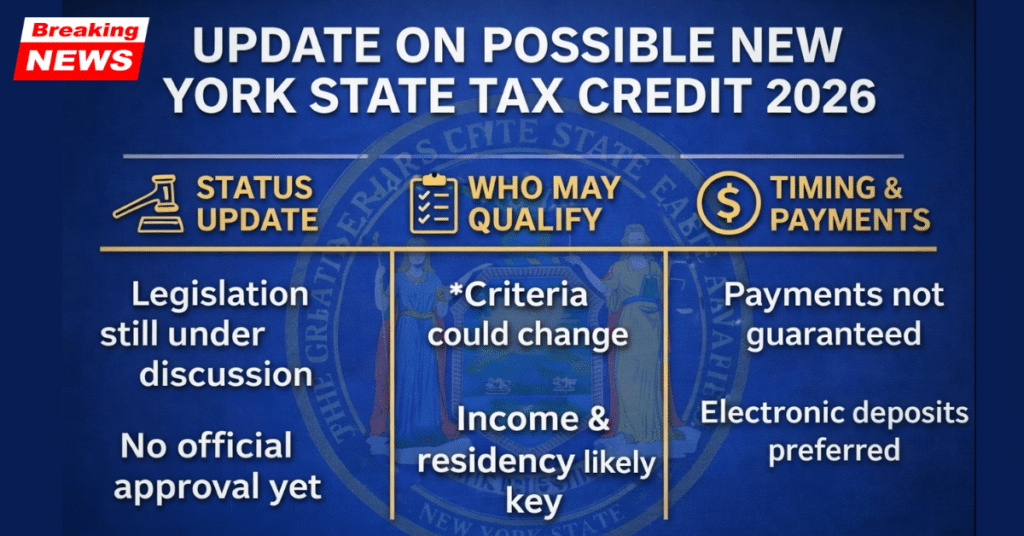
There is no single, automatic $1,000 tax credit approved for all New York residents in 2026. Any benefit near that amount applies only to certain eligible taxpayers, based on income, household status, and rules written into state law or the final budget.
When credits are enacted, New York State clearly outlines them through the Department of Taxation and Finance, including eligibility rules and how to claim them. If it’s not in official guidance, it’s not guaranteed.
Who could qualify if a credit applies
Eligibility depends entirely on how a specific credit is structured. Historically, New York tax credits tend to focus on low- to middle-income households, families with dependents, or workers meeting defined criteria.
Most credits require taxpayers to:
- Be New York State residents during the tax year
- File a New York State income tax return
- Stay within income limits set by law
- Meet household or dependent requirements
Credits are never automatic. Filing a return is required, even if no tax is owed.
How the credit would be paid
State tax credits are typically applied in one of two ways. Some reduce the amount of state tax owed. Others are refundable, meaning a payment may be issued after the return is processed if the credit exceeds the tax liability.
Refund timing depends on filing accuracy, review status, and whether direct deposit is selected.
Expected payment timing in 2026
If a refundable credit applies, payments would follow the normal tax cycle. Most New York returns are filed in early 2026, reviewed shortly afterward, and refunds are generally issued in spring or early summer. Direct deposit usually arrives faster than paper checks.
There is no fixed payment date that applies to everyone.
ALSO READ: Is SNAP Really Going Away in 2026?
Why many residents won’t receive $1,000
The $1,000 number represents a maximum possible benefit, not a guaranteed amount. Some eligible taxpayers may receive less, while others may not qualify at all due to income thresholds or filing status.
This is why expectations based on headlines alone often lead to confusion.
How this differs from federal payments
This is a state-level tax benefit, not a federal stimulus or IRS-issued payment. It is funded and managed solely by New York State and does not arrive as an automatic deposit without filing a return.
Claims suggesting otherwise are inaccurate.
What New York residents should do now
The most practical step is preparation. File state taxes accurately and on time, and review official eligibility rules once they are released. Keeping banking details current can also help ensure faster refunds if a credit is refundable.
Why accurate information matters
Tax credits are rule-based and specific. Misinformation can create false expectations or cause people to miss benefits they actually qualify for. Official state guidance remains the only reliable confirmation of eligibility and payment details.
ALSO READ: Why Some Filers Are Seeing a $400 IRS Refund Change
Conclusion
The idea of a $1,000 New York State tax credit in 2026 reflects ongoing efforts to provide targeted tax relief, not a guaranteed payout for every resident. Any benefit depends on specific eligibility rules, income limits, and timely filing of a New York State tax return. While some households may qualify for a meaningful credit, others may receive a smaller amount or none at all. For accurate expectations, New York residents should rely only on official state guidance and finalized budget provisions as the 2026 tax season approaches.
Disclaimer: This article is for general informational purposes only. New York State tax credits, eligibility requirements, and payment timelines are subject to change based on legislation and official guidance. Always consult New York State Department of Taxation and Finance resources or a qualified tax professional for personalized advice.

Written by our editorial team, committed to accurate and responsible reporting.